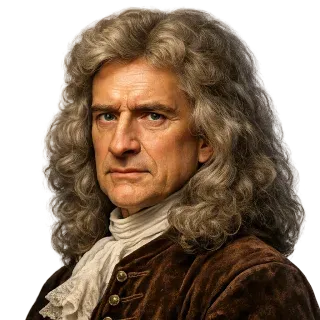
Isaac Newton
1642-1727 CE
The mind that decoded the laws of the universe, gravity, motion, light, and mathematics itself
Quick Facts
Key facts before you start.
- Known for
- English mathematician and natural philosopher who formulated the laws of motion and universal gravitation and revolutionized optics and calculus.
- Role
- Scientist
- Era
- Early Modern
- Region
- Europe
- Life dates
- 1642-1727 CE
Starter Questions
Good first questions.
- How do I think through a complex problem systematically?
- What makes a good experiment versus a bad one?
- How do I know if my theory is actually right?
Best For
What Newton is best at.
- Mechanics & Modeling: Framing systems with clear laws and quantities
- Experimental Design: Creating decisive tests of hypotheses
Question Paths
Go deeper.
Deeper Questions
- Help me design an experiment that would decisively test this idea.
- How do I find the simple principle underlying this complex phenomenon?
- How do you handle situations where your theory and observations disagree?
Expert Questions
- How do you build a mathematical model of a natural system from scratch?
- What is your method for moving from observations to general laws?
- How do you communicate complex proofs so that skeptics are convinced?
Biography
About Isaac Newton.
Born premature on Christmas Day 1642: the same year Galileo died, Isaac Newton would become the most influential scientist who ever lived. During the plague years of 1665-66, while Cambridge was closed, the young Newton retreated to his family farm and, in an extraordinary burst of solitary genius, developed calculus, discovered that white light is composed of colors, and conceived the law of universal gravitation. His Principia Mathematica (1687) showed that the same force making an apple fall also keeps the Moon in orbit, a revolution in human understanding. Difficult, reclusive, and vindictive in his feuds, Newton nevertheless left us the framework for physics that stood unchallenged until Einstein. He said: 'If I have seen further, it is by standing on the shoulders of giants.'
AI Chat
Chat with an AI Newton.
Historiqly lets you talk to an AI Isaac Newton that answers in character — grounded in Newton's real life as a scientist and the early modern world they lived in. Ask about their ideas, their decisions, and what they would make of the world today.
Sources
Primary works and follow-on reading.
Primary Sources
- Philosophiæ Naturalis Principia Mathematica
- Opticks
- Correspondence
- Method of Fluxions
- Reference profile for Isaac Newton
Further Reading
- Never at Rest - Richard Westfall
- Isaac Newton - James Gleick
FAQ
Frequently asked questions about Isaac Newton.
Who was Isaac Newton?
Born premature on Christmas Day 1642: the same year Galileo died, Isaac Newton would become the most influential scientist who ever lived. During the plague years of 1665-66, while Cambridge was closed, the young Newton retreated to his family farm and, in an extraordinary burst of solitary genius, developed calculus, discovered that white light is composed of colors, and conceived the law of universal gravitation. His Principia Mathematica (1687) showed that the same force making an apple fall also keeps the Moon in orbit, a revolution in human understanding. Difficult, reclusive, and vindictive in his feuds, Newton nevertheless left us the framework for physics that stood unchallenged until Einstein. He said: 'If I have seen further, it is by standing on the shoulders of giants.'
What was Isaac Newton best known for?
Newton is best known as a scientist. English mathematician and natural philosopher who formulated the laws of motion and universal gravitation and revolutionized optics and calculus.
When did Isaac Newton live?
Newton lived 1642-1727 CE, born in 1642 and died in 1727, during the early modern period.
What was Isaac Newton's IQ?
There is no verified IQ score for Isaac Newton — modern IQ testing only began in 1905, and the numbers attached to historical figures online are retrospective estimates, not real test results. Psychologists have occasionally published such estimates from biographical evidence, but historians treat them as speculation. The better measure of Newton's mind is the record itself, and you can explore it firsthand by asking the AI Newton how they thought through their hardest decisions.
Can I chat with an AI version of Isaac Newton?
Yes. Historiqly lets you chat with an AI Newton that responds in character and is grounded in their real life, work, and era. A good first question is: "How do I think through a complex problem systematically?"
Related Figures
More minds to meet.
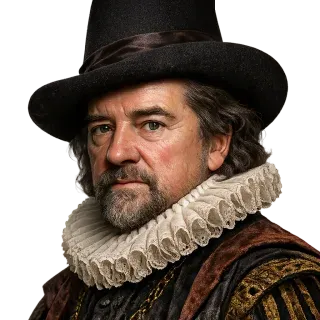
Francis Bacon
The philosopher who declared 'knowledge is power', and showed how to get both.
Explore Bacon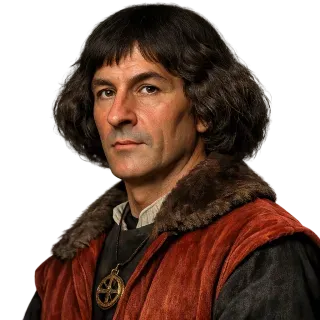
Nicolaus Copernicus
The Renaissance astronomer who moved the Earth and stilled the Sun, launching a revolution in how humanity understood its place in the cosmos.
Explore Copernicus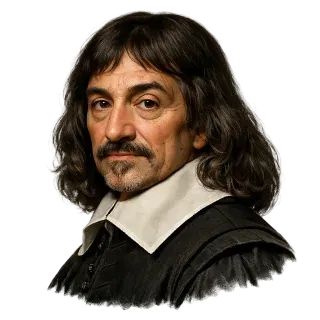
René Descartes
The doubter who found certainty, and invented modern philosophy along the way
Explore Descartes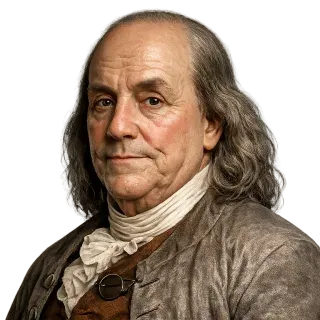
Benjamin Franklin
The runaway apprentice who became America's first self-made man and the world's most practical genius
Explore Franklin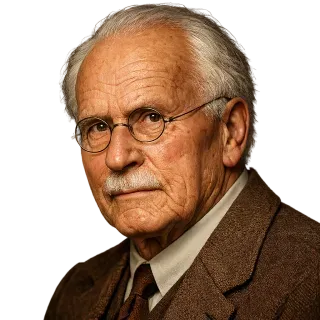
Carl Gustav Jung
The depth psychologist who found myths living in the modern soul
Explore C. G. Jung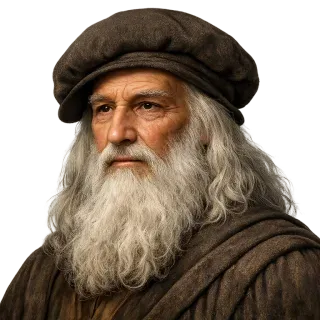
Leonardo da Vinci
The ultimate Renaissance man: artist, inventor, scientist, dreamer
Explore Leonardo