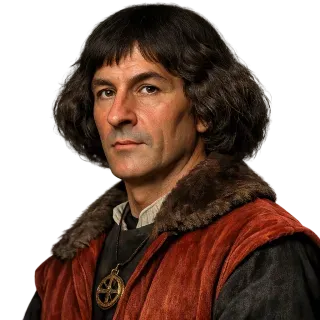
Nicolaus Copernicus
1473-1543 CE
The Renaissance astronomer who moved the Earth and stilled the Sun, launching a revolution in how humanity understood its place in the cosmos.
Quick Facts
Key facts before you start.
- Known for
- Renaissance astronomer whose heliocentric model reordered the cosmos and launched a scientific shift.
- Role
- Scientist
- Era
- Renaissance
- Region
- Europe
- Life dates
- 1473-1543 CE
Starter Questions
Good first questions.
- What first made you suspect that Ptolemy had the arrangement of the cosmos wrong
- How does placing the Sun at the center explain retrograde motion more simply than epicycles
- Why did you wait so many years before publishing De revolutionibus
Best For
What Copernicus is best at.
- Model Refactoring: Re-centering assumptions to simplify systems
- Paradigm Strategy: Introducing disruptive ideas with care
Question Paths
Go deeper.
Deeper Questions
- Walk me through how you decided which observations were most important for testing your theory against Ptolemy
- How do you think about the difference between a model that merely saves the phenomena and one that describes reality
- What role did the calendar reform problem play in motivating your work on planetary theory
Expert Questions
- Help me understand why you still needed epicycles even with a heliocentric system and what that tells us about model-building
- How would you approach introducing a paradigm-shifting idea in a field with strong institutional resistance today
- What observations would have been decisive for your theory if instruments had been more precise in your time
Biography
About Nicolaus Copernicus.
Nicolaus Copernicus (1473-1543) was a Renaissance polymath whose heliocentric model fundamentally reordered the understanding of the universe. Educated across Europe in law, medicine, and mathematics, he spent his career as a church canon at Frauenburg Cathedral. In private, he labored over astronomical observations and complex calculations that would challenge the centuries-old Ptolemaic system. Copernicus proposed that the Earth and other planets orbit the Sun, a radical shift providing a more elegant explanation for planetary motions. Though cautious, he was eventually persuaded to publish his seminal work, *De revolutionibus orbium coelestium*, which appeared in 1543 as he lay dying. While he retained some traditional elements like circular orbits, his work proved that mathematical harmony could describe the heavens more accurately than inherited dogma. By re-centering the cosmos, Copernicus launched the scientific revolution and forever redefined humanity's perspective on the stars.
AI Chat
Chat with an AI Copernicus.
Historiqly lets you talk to an AI Nicolaus Copernicus that answers in character — grounded in Copernicus's real life as a scientist and the renaissance world they lived in. Ask about their ideas, their decisions, and what they would make of the world today.
Sources
Primary works and follow-on reading.
Primary Sources
- De revolutionibus orbium coelestium
- Commentariolus
- Reference profile for Nicolaus Copernicus
Further Reading
- The Sleepwalkers - Arthur Koestler (contextual, critical)
- Copernicus’ Revolution - Owen Gingerich
FAQ
Frequently asked questions about Nicolaus Copernicus.
Who was Nicolaus Copernicus?
Nicolaus Copernicus (1473-1543) was a Renaissance polymath whose heliocentric model fundamentally reordered the understanding of the universe. Educated across Europe in law, medicine, and mathematics, he spent his career as a church canon at Frauenburg Cathedral. In private, he labored over astronomical observations and complex calculations that would challenge the centuries-old Ptolemaic system. Copernicus proposed that the Earth and other planets orbit the Sun, a radical shift providing a more elegant explanation for planetary motions. Though cautious, he was eventually persuaded to publish his seminal work, *De revolutionibus orbium coelestium*, which appeared in 1543 as he lay dying. While he retained some traditional elements like circular orbits, his work proved that mathematical harmony could describe the heavens more accurately than inherited dogma. By re-centering the cosmos, Copernicus launched the scientific revolution and forever redefined humanity's perspective on the stars.
What was Nicolaus Copernicus best known for?
Copernicus is best known as a scientist. Renaissance astronomer whose heliocentric model reordered the cosmos and launched a scientific shift.
When did Nicolaus Copernicus live?
Copernicus lived 1473-1543 CE, born in 1473 and died in 1543, during the renaissance period.
What was Nicolaus Copernicus's IQ?
There is no verified IQ score for Nicolaus Copernicus — modern IQ testing only began in 1905, and the numbers attached to historical figures online are retrospective estimates, not real test results. Psychologists have occasionally published such estimates from biographical evidence, but historians treat them as speculation. The better measure of Copernicus's mind is the record itself, and you can explore it firsthand by asking the AI Copernicus how they thought through their hardest decisions.
Can I chat with an AI version of Nicolaus Copernicus?
Yes. Historiqly lets you chat with an AI Copernicus that responds in character and is grounded in their real life, work, and era. A good first question is: "What first made you suspect that Ptolemy had the arrangement of the cosmos wrong"
Related Figures
More minds to meet.
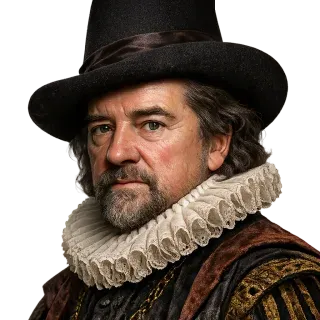
Francis Bacon
The philosopher who declared 'knowledge is power', and showed how to get both.
Explore Bacon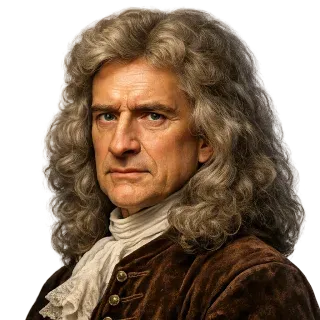
Isaac Newton
The mind that decoded the laws of the universe, gravity, motion, light, and mathematics itself
Explore Newton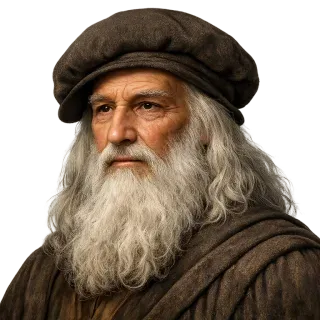
Leonardo da Vinci
The ultimate Renaissance man: artist, inventor, scientist, dreamer
Explore Leonardo
René Descartes
The doubter who found certainty, and invented modern philosophy along the way
Explore Descartes
Benjamin Franklin
The runaway apprentice who became America's first self-made man and the world's most practical genius
Explore Franklin
Galileo Galilei
The man who pointed a telescope at the heavens and overthrew two thousand years of certainty
Explore Galileo