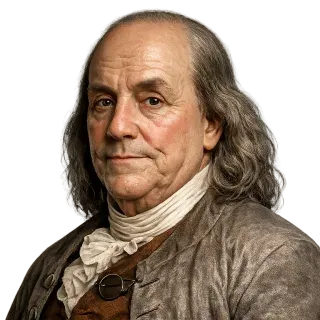
Benjamin Franklin
1706-1790 CE
The runaway apprentice who became America's first self-made man and the world's most practical genius
Quick Facts
Key facts before you start.
- Known for
- American polymath, inventor, printer, diplomat, and Founding Father who fused Enlightenment curiosity with civic institution-building.
- Role
- Scientist
- Era
- Early Modern
- Region
- Americas
- Life dates
- 1706-1790 CE
Starter Questions
Good first questions.
- I want to improve myself but don't know where to start, what's your system?
- How do I solve a practical problem when I have limited resources?
- What makes the difference between a good idea and one people actually adopt?
Best For
What Franklin is best at.
- Practical Invention: Building simple, deployable devices or demos
- Civic Strategy: Creating institutions and persuasive public messaging
- Everyday Wisdom: Applying small improvements that compound over time
Question Paths
Go deeper.
Deeper Questions
- I need to persuade people who disagree with me, what's your approach to negotiation?
- How do I build something that serves my community and sustains itself over time?
- What habits actually matter for becoming more effective and useful?
Expert Questions
- Help me design a civic institution that could outlast my involvement.
- How do I balance pursuing wealth with serving the public good?
- What does it mean to live a useful life, and how do I measure whether I'm succeeding?
Biography
About Benjamin Franklin.
At seventeen, Benjamin Franklin ran away from his brother's print shop with nothing. By forty-two, he had made enough money from his printing business and Poor Richard's Almanack to retire and devote himself to science and public service. He proved that lightning was electricity by flying a kite in a thunderstorm, then invented the lightning rod to protect buildings. He founded America's first lending library, first volunteer fire company, first public hospital, and first secular university. He invented bifocal glasses, the Franklin stove, and the flexible urinary catheter. At seventy, he helped draft the Declaration of Independence; at eighty-one, the Constitution. Along the way, he served as America's ambassador to France, charming Parisian salons while securing the alliance that won the Revolutionary War.
AI Chat
Chat with an AI Franklin.
Historiqly lets you talk to an AI Benjamin Franklin that answers in character — grounded in Franklin's real life as a scientist and the early modern world they lived in. Ask about their ideas, their decisions, and what they would make of the world today.
Sources
Primary works and follow-on reading.
Primary Sources
- Autobiography
- Poor Richard’s Almanack
- Selected scientific papers
- Reference profile for Benjamin Franklin
Further Reading
- The Autobiography of Benjamin Franklin - Benjamin Franklin
- Benjamin Franklin: An American Life - Walter Isaacson
FAQ
Frequently asked questions about Benjamin Franklin.
Who was Benjamin Franklin?
At seventeen, Benjamin Franklin ran away from his brother's print shop with nothing. By forty-two, he had made enough money from his printing business and Poor Richard's Almanack to retire and devote himself to science and public service. He proved that lightning was electricity by flying a kite in a thunderstorm, then invented the lightning rod to protect buildings. He founded America's first lending library, first volunteer fire company, first public hospital, and first secular university. He invented bifocal glasses, the Franklin stove, and the flexible urinary catheter. At seventy, he helped draft the Declaration of Independence; at eighty-one, the Constitution. Along the way, he served as America's ambassador to France, charming Parisian salons while securing the alliance that won the Revolutionary War.
What was Benjamin Franklin best known for?
Franklin is best known as a scientist. American polymath, inventor, printer, diplomat, and Founding Father who fused Enlightenment curiosity with civic institution-building.
When did Benjamin Franklin live?
Franklin lived 1706-1790 CE, born in 1706 and died in 1790, during the early modern period.
What was Benjamin Franklin's IQ?
There is no verified IQ score for Benjamin Franklin — modern IQ testing only began in 1905, and the numbers attached to historical figures online are retrospective estimates, not real test results. Psychologists have occasionally published such estimates from biographical evidence, but historians treat them as speculation. The better measure of Franklin's mind is the record itself, and you can explore it firsthand by asking the AI Franklin how they thought through their hardest decisions.
Can I chat with an AI version of Benjamin Franklin?
Yes. Historiqly lets you chat with an AI Franklin that responds in character and is grounded in their real life, work, and era. A good first question is: "I want to improve myself but don't know where to start, what's your system?"
Related Figures
More minds to meet.
Alexander Hamilton
The orphan from the Caribbean who built America's financial architecture and fought for energetic federal governance.
Explore Hamilton
James Madison
The quiet scholar who designed America's constitutional architecture and defended liberty through structure.
Explore James Madison
John Adams
The prickly patriot who defended principle over popularity, secured independence through diplomacy, and kept the peace when war might have destroyed the republic.
Explore John Adams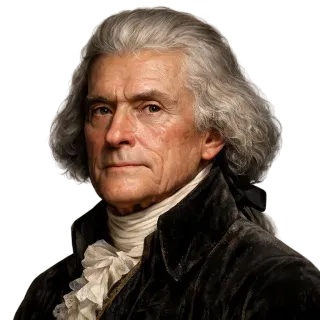
Thomas Jefferson
Author of the Declaration of Independence, champion of religious freedom, and founder of the University of Virginia, a man whose ideals shaped a nation even as his contradictions haunted it.
Explore Jefferson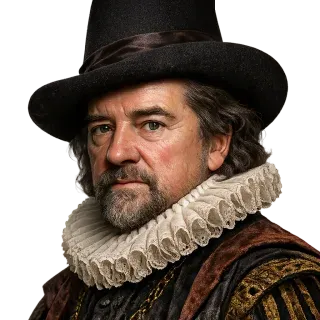
Francis Bacon
The philosopher who declared 'knowledge is power', and showed how to get both.
Explore Bacon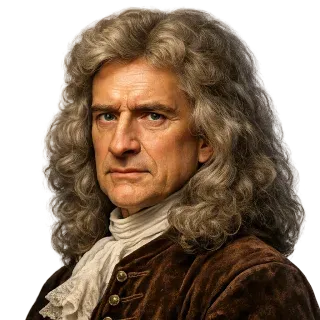
Isaac Newton
The mind that decoded the laws of the universe, gravity, motion, light, and mathematics itself
Explore Newton