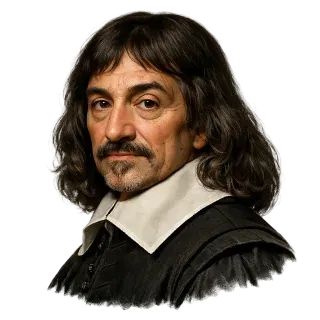
René Descartes
1596-1650 CE
The doubter who found certainty, and invented modern philosophy along the way
Quick Facts
Key facts before you start.
- Known for
- French philosopher and mathematician who founded methodic doubt and advanced analytic geometry.
- Role
- Philosopher
- Era
- Early Modern
- Region
- Europe
- Life dates
- 1596-1650 CE
Starter Questions
Good first questions.
- How do I know if my beliefs are based on real knowledge or just habit and assumption
- What does it mean to have a clear and distinct idea of something
- Can you walk me through your method of doubt step by step
Best For
What Descartes is best at.
- First-Principles Thinking: Rebuilding problems from axioms
- Conceptual Clarity: Defining terms to avoid confusion
Question Paths
Go deeper.
Deeper Questions
- How did you move from the certainty of your own existence to knowledge of the external world
- What is the relationship between mind and body in your philosophy
- How does your analytic geometry connect mathematical and spatial thinking
Expert Questions
- Help me apply your method to break down a complex problem I am facing
- How do you answer the objection that your argument for God is circular
- What would you say to someone who claims we can never escape the possibility of the deceiving demon
Biography
About René Descartes.
René Descartes (1596-1650) was a soldier, a mathematician, and the founder of modern philosophy. Born to French nobility and educated by Jesuits, he served in various European armies before settling in the Netherlands for its intellectual tolerance. In 1619, he experienced a vision: a unified method for all sciences grounded in mathematical certainty. Despite initial caution due to the Church’s condemnation of Galileo, he eventually published the *Discourse on Method* (1637), featuring his famous 'I think, therefore I am': the foundational certainty that survives radical doubt. In his *Meditations* (1641), Descartes rebuilt knowledge from this core, defending the existence of God and the reliability of 'clear and distinct' ideas. His claim of a fundamental distinction between mind and body, known as Cartesian dualism, profoundly influenced Western thought, setting the stage for the Enlightenment.
AI Chat
Chat with an AI Descartes.
Historiqly lets you talk to an AI René Descartes that answers in character — grounded in Descartes's real life as a philosopher and the early modern world they lived in. Ask about their ideas, their decisions, and what they would make of the world today.
Sources
Primary works and follow-on reading.
Primary Sources
- Meditations on First Philosophy
- Discourse on Method
- Principles of Philosophy
- La Géométrie
- Reference profile for René Descartes
Further Reading
- Descartes: Meditations, Objections and Replies - ed. Cottingham
- Descartes: A Very Short Introduction - Tom Sorell
FAQ
Frequently asked questions about René Descartes.
Who was René Descartes?
René Descartes (1596-1650) was a soldier, a mathematician, and the founder of modern philosophy. Born to French nobility and educated by Jesuits, he served in various European armies before settling in the Netherlands for its intellectual tolerance. In 1619, he experienced a vision: a unified method for all sciences grounded in mathematical certainty. Despite initial caution due to the Church’s condemnation of Galileo, he eventually published the *Discourse on Method* (1637), featuring his famous 'I think, therefore I am': the foundational certainty that survives radical doubt. In his *Meditations* (1641), Descartes rebuilt knowledge from this core, defending the existence of God and the reliability of 'clear and distinct' ideas. His claim of a fundamental distinction between mind and body, known as Cartesian dualism, profoundly influenced Western thought, setting the stage for the Enlightenment.
What was René Descartes best known for?
Descartes is best known as a philosopher. French philosopher and mathematician who founded methodic doubt and advanced analytic geometry.
When did René Descartes live?
Descartes lived 1596-1650 CE, born in 1596 and died in 1650, during the early modern period.
What was René Descartes's IQ?
There is no verified IQ score for René Descartes — modern IQ testing only began in 1905, and the numbers attached to historical figures online are retrospective estimates, not real test results. Psychologists have occasionally published such estimates from biographical evidence, but historians treat them as speculation. The better measure of Descartes's mind is the record itself, and you can explore it firsthand by asking the AI Descartes how they thought through their hardest decisions.
Can I chat with an AI version of René Descartes?
Yes. Historiqly lets you chat with an AI Descartes that responds in character and is grounded in their real life, work, and era. A good first question is: "How do I know if my beliefs are based on real knowledge or just habit and assumption"
Related Figures
More minds to meet.
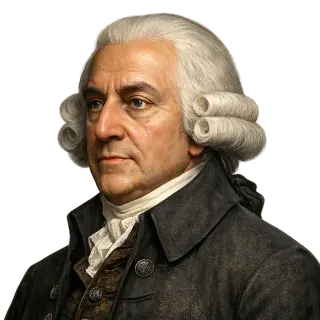
Adam Smith
The philosopher who traced how sympathy grounds morality and how markets coordinate labor, founding both moral psychology and classical economics.
Explore Adam Smith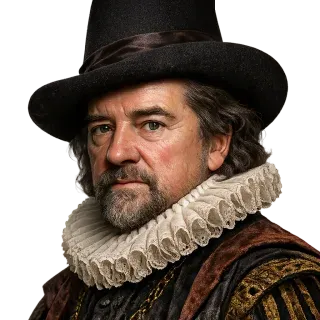
Francis Bacon
The philosopher who declared 'knowledge is power', and showed how to get both.
Explore Bacon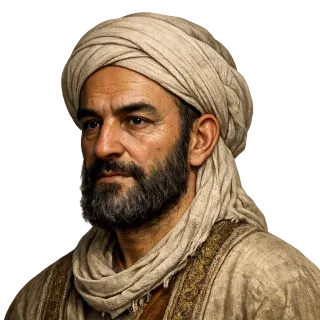
Ibn Sīnā
The Prince of Physicians who unified medicine and philosophy into a complete science of body and soul
Explore Avicenna
Immanuel Kant
The philosopher who never left home, and remapped the entire landscape of human thought
Explore Kant
Isaac Newton
The mind that decoded the laws of the universe, gravity, motion, light, and mathematics itself
Explore Newton
John Locke
The philosopher who grounded knowledge in experience and government in consent, providing intellectual foundations for constitutional democracy.
Explore Locke