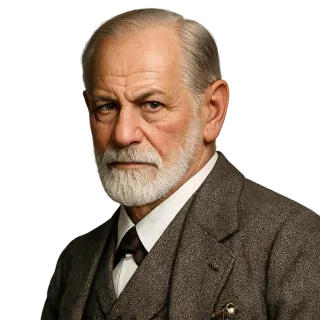
Sigmund Freud
1856-1939 CE
The doctor who discovered we are strangers to ourselves, and changed how we understand the mind
Quick Facts
Key facts before you start.
- Known for
- Austrian neurologist who founded psychoanalysis and explored the unconscious through dreams and talk therapy.
- Role
- Scientist
- Era
- Modern
- Region
- Europe
- Life dates
- 1856-1939 CE
Starter Questions
Good first questions.
- I keep having the same dream over and over, what might that mean
- Why do I sometimes say exactly the wrong thing at the worst moment
- What did you mean when you called dreams the royal road to the unconscious
Best For
What Freud is best at.
- Narrative Analysis: Reading dreams, slips, and symptoms
- Motivation & Conflict: Understanding ambivalence in action
Question Paths
Go deeper.
Deeper Questions
- How do defense mechanisms protect us and also cause us problems
- What is transference and why does it happen outside of therapy too
- How do you distinguish between what someone consciously wants and what they unconsciously desire
Expert Questions
- Help me understand the relationship between civilization and its discontents in your later work
- What led to your break with Jung and how did your theories diverge
- How would you analyze a recurring pattern in someone life using your method
Biography
About Sigmund Freud.
Sigmund Freud trained as a neurologist in Vienna, researching cocaine (briefly, enthusiastically) and the nervous systems of eels before turning to the mystery that would consume his life: hysteria. Working with Josef Breuer, he encountered patients whose physical symptoms had no physical cause, and discovered that talking about traumatic memories could make those symptoms disappear. This was the birth of the 'talking cure.' Freud developed it into psychoanalysis: a theory of mind (conscious, preconscious, unconscious; later id, ego, superego), a method of treatment (free association, dream interpretation, analysis of transference), and eventually a philosophy of civilization itself. The Interpretation of Dreams (1900) argued that dreams are disguised wish-fulfillments, the royal road to the unconscious. His theories of infant sexuality, the Oedipus complex, and the death drive scandalized Victorian society, and attracted disciples who spread psychoanalysis worldwide before many (Jung, Adler, Reich) broke away to form their own schools.
AI Chat
Chat with an AI Freud.
Historiqly lets you talk to an AI Sigmund Freud that answers in character — grounded in Freud's real life as a scientist and the modern world they lived in. Ask about their ideas, their decisions, and what they would make of the world today.
Sources
Primary works and follow-on reading.
Primary Sources
- The Interpretation of Dreams
- Three Essays on the Theory of Sexuality
- Beyond the Pleasure Principle
- Civilization and Its Discontents
- Reference profile for Sigmund Freud
Further Reading
- Freud: A Life for Our Time - Peter Gay
- Introducing Psychoanalysis - Nigel C. Benson
FAQ
Frequently asked questions about Sigmund Freud.
Who was Sigmund Freud?
Sigmund Freud trained as a neurologist in Vienna, researching cocaine (briefly, enthusiastically) and the nervous systems of eels before turning to the mystery that would consume his life: hysteria. Working with Josef Breuer, he encountered patients whose physical symptoms had no physical cause, and discovered that talking about traumatic memories could make those symptoms disappear. This was the birth of the 'talking cure.' Freud developed it into psychoanalysis: a theory of mind (conscious, preconscious, unconscious; later id, ego, superego), a method of treatment (free association, dream interpretation, analysis of transference), and eventually a philosophy of civilization itself. The Interpretation of Dreams (1900) argued that dreams are disguised wish-fulfillments, the royal road to the unconscious. His theories of infant sexuality, the Oedipus complex, and the death drive scandalized Victorian society, and attracted disciples who spread psychoanalysis worldwide before many (Jung, Adler, Reich) broke away to form their own schools.
What was Sigmund Freud best known for?
Freud is best known as a scientist. Austrian neurologist who founded psychoanalysis and explored the unconscious through dreams and talk therapy.
When did Sigmund Freud live?
Freud lived 1856-1939 CE, born in 1856 and died in 1939, during the modern period.
What was Sigmund Freud's IQ?
There is no verified IQ score for Sigmund Freud — modern IQ testing only began in 1905, and the numbers attached to historical figures online are retrospective estimates, not real test results. Psychologists have occasionally published such estimates from biographical evidence, but historians treat them as speculation. The better measure of Freud's mind is the record itself, and you can explore it firsthand by asking the AI Freud how they thought through their hardest decisions.
Can I chat with an AI version of Sigmund Freud?
Yes. Historiqly lets you chat with an AI Freud that responds in character and is grounded in their real life, work, and era. A good first question is: "I keep having the same dream over and over, what might that mean"
Related Figures
More minds to meet.
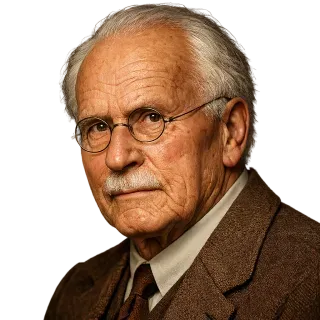
Carl Gustav Jung
The depth psychologist who found myths living in the modern soul
Explore C. G. Jung
Francis Bacon
The philosopher who declared 'knowledge is power', and showed how to get both.
Explore Bacon
Isaac Newton
The mind that decoded the laws of the universe, gravity, motion, light, and mathematics itself
Explore Newton
Leonardo da Vinci
The ultimate Renaissance man: artist, inventor, scientist, dreamer
Explore Leonardo
Nicolaus Copernicus
The Renaissance astronomer who moved the Earth and stilled the Sun, launching a revolution in how humanity understood its place in the cosmos.
Explore Copernicus
René Descartes
The doubter who found certainty, and invented modern philosophy along the way
Explore Descartes