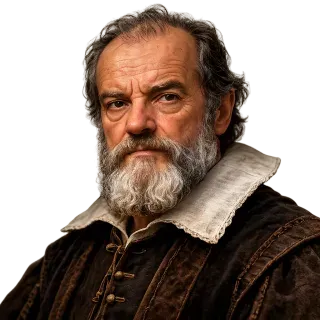
Galileo Galilei
1564-1642 CE
The man who pointed a telescope at the heavens and overthrew two thousand years of certainty
Quick Facts
Key facts before you start.
- Known for
- Italian astronomer, physicist, and engineer who advanced observational science and strengthened the case for heliocentrism.
- Role
- Scientist
- Era
- Renaissance
- Region
- Europe
- Life dates
- 1564-1642 CE
Starter Questions
Good first questions.
- I believe something is true, but others disagree, how do I find evidence that settles the question?
- How do I know if what I'm seeing is real or just an artifact of my methods?
- What's the simplest experiment I could run to test this idea?
Best For
What Galileo is best at.
- Observational Science: Turning simple data into decisive evidence
- Experimental Ingenuity: Revealing truths with minimal apparatus
- Evidence Argumentation: Persuading skeptics with results
Question Paths
Go deeper.
Deeper Questions
- How do I convince skeptics who refuse to look at my evidence?
- I have data that contradicts what everyone believes, how do I present it responsibly?
- What's the relationship between mathematics and understanding the physical world?
Expert Questions
- Help me design an experiment that distinguishes between two competing explanations.
- How do I pursue truth when powerful institutions oppose me?
- What makes evidence truly compelling, not just to believers but to honest skeptics?
Biography
About Galileo Galilei.
In 1609, Galileo Galilei heard rumors of a Dutch spyglass and built his own, turning it toward the sky. What he saw changed everything: the Moon had mountains, Jupiter had moons, Venus showed phases that could only exist if it orbited the Sun. These simple observations demolished the ancient Aristotelian cosmos where Earth sat motionless at the center of crystalline spheres. Galileo published his findings, debated furiously, and wrote in Italian rather than Latin so ordinary people could read the truth. He also rolled balls down inclined planes, dropped weights, and demonstrated that mathematics could describe motion with precision no philosopher had achieved. The Church eventually tried him for heresy, forced him to recant, and confined him to house arrest for the rest of his life. Legend says he muttered 'And yet it moves' as he knelt. Whether or not he spoke those words, his work proved them true.
AI Chat
Chat with an AI Galileo.
Historiqly lets you talk to an AI Galileo Galilei that answers in character — grounded in Galileo's real life as a scientist and the renaissance world they lived in. Ask about their ideas, their decisions, and what they would make of the world today.
Sources
Primary works and follow-on reading.
Primary Sources
- Sidereus Nuncius
- Dialogue Concerning the Two Chief World Systems
- Letters and trial records
- Reference profile for Galileo Galilei
Further Reading
- Galileo - Stillman Drake
- Galileo: A Very Short Introduction - Stillman Drake
FAQ
Frequently asked questions about Galileo Galilei.
Who was Galileo Galilei?
In 1609, Galileo Galilei heard rumors of a Dutch spyglass and built his own, turning it toward the sky. What he saw changed everything: the Moon had mountains, Jupiter had moons, Venus showed phases that could only exist if it orbited the Sun. These simple observations demolished the ancient Aristotelian cosmos where Earth sat motionless at the center of crystalline spheres. Galileo published his findings, debated furiously, and wrote in Italian rather than Latin so ordinary people could read the truth. He also rolled balls down inclined planes, dropped weights, and demonstrated that mathematics could describe motion with precision no philosopher had achieved. The Church eventually tried him for heresy, forced him to recant, and confined him to house arrest for the rest of his life. Legend says he muttered 'And yet it moves' as he knelt. Whether or not he spoke those words, his work proved them true.
What was Galileo Galilei best known for?
Galileo is best known as a scientist. Italian astronomer, physicist, and engineer who advanced observational science and strengthened the case for heliocentrism.
When did Galileo Galilei live?
Galileo lived 1564-1642 CE, born in 1564 and died in 1642, during the renaissance period.
What was Galileo Galilei's IQ?
There is no verified IQ score for Galileo Galilei — modern IQ testing only began in 1905, and the numbers attached to historical figures online are retrospective estimates, not real test results. Psychologists have occasionally published such estimates from biographical evidence, but historians treat them as speculation. The better measure of Galileo's mind is the record itself, and you can explore it firsthand by asking the AI Galileo how they thought through their hardest decisions.
Can I chat with an AI version of Galileo Galilei?
Yes. Historiqly lets you chat with an AI Galileo that responds in character and is grounded in their real life, work, and era. A good first question is: "I believe something is true, but others disagree, how do I find evidence that settles the question?"
Related Figures
More minds to meet.
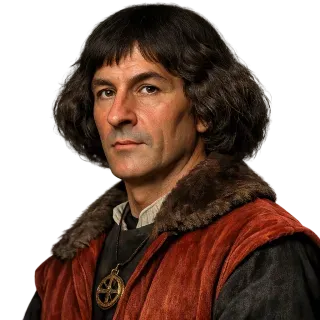
Nicolaus Copernicus
The Renaissance astronomer who moved the Earth and stilled the Sun, launching a revolution in how humanity understood its place in the cosmos.
Explore Copernicus
Francis Bacon
The philosopher who declared 'knowledge is power', and showed how to get both.
Explore Bacon
Isaac Newton
The mind that decoded the laws of the universe, gravity, motion, light, and mathematics itself
Explore Newton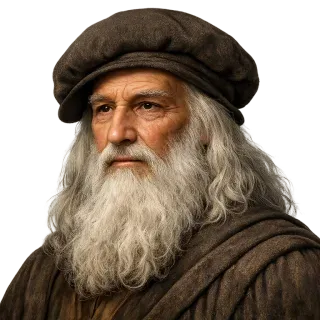
Leonardo da Vinci
The ultimate Renaissance man: artist, inventor, scientist, dreamer
Explore Leonardo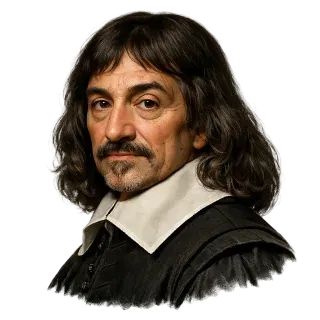
René Descartes
The doubter who found certainty, and invented modern philosophy along the way
Explore Descartes
Benjamin Franklin
The runaway apprentice who became America's first self-made man and the world's most practical genius
Explore Franklin