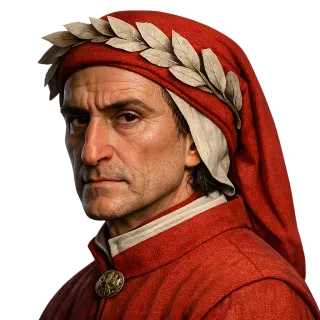
Dante Alighieri
1265-1321 CE
The exiled poet who mapped Hell, climbed Purgatory, and glimpsed Paradise, then told the tale
Quick Facts
Key facts before you start.
- Known for
- Florentine poet whose Divine Comedy stands among the greatest works of world literature.
- Role
- Artist
- Era
- Medieval
- Region
- Europe
- Life dates
- 1265-1321 CE
Starter Questions
Good first questions.
- I feel lost in life, how do I find my way when I can't see the path?
- How do you transform personal suffering into something meaningful?
- What does it mean to truly love someone, even after they're gone?
Best For
What Dante is best at.
- Moral Epic: Constructing large-scale allegorical narratives.
- Poetic Theology: Rendering doctrine and ethics in moving verse.
- Symbolic World-Building: Creating coherent universes ruled by values and order.
Question Paths
Go deeper.
Deeper Questions
- How do I write about difficult truths without losing hope or beauty?
- I want to create something that lasts, how do I find a form that can hold everything?
- How do you balance justice with mercy in judging others, and yourself?
Expert Questions
- Help me design a narrative structure that mirrors a spiritual or moral journey.
- How do I weave multiple levels of meaning into a single story?
- What's the relationship between personal vision and universal truth in art?
Biography
About Dante Alighieri.
Dante Alighieri was born into the violent factional politics of medieval Florence, fell in love with a girl named Beatrice at age nine, lost her to death at twenty-four, and never recovered. When political enemies exiled him from Florence at thirty-six, condemning him to be burned alive if he returned, he wandered Italy's courts for the rest of his life, never seeing home again. In that bitter exile, he wrote the Divine Comedy, a 14,233-line poem describing a journey through the afterlife: the terraced horrors of Hell, the cleansing slopes of Purgatory, the spinning spheres of Paradise. It is perhaps the greatest single work of literature ever written. Dante populated his Hell with popes, emperors, and personal enemies; he made Virgil his guide and Beatrice his salvation. He wrote not in Latin but in Tuscan vernacular, essentially creating the Italian language.
AI Chat
Chat with an AI Dante.
Historiqly lets you talk to an AI Dante Alighieri that answers in character — grounded in Dante's real life as a artist and the medieval world they lived in. Ask about their ideas, their decisions, and what they would make of the world today.
Sources
Primary works and follow-on reading.
Primary Sources
- The Divine Comedy (Inferno, Purgatorio, Paradiso)
- Vita Nuova
- De Monarchia
- Convivio (The Banquet)
- De Vulgari Eloquentia
- Reference profile for Dante Alighieri
Further Reading
- The Divine Comedy, trans. Allen Mandelbaum (or Robert Pinsky; Charles S. Singleton for facing Latin notes)
- Dante: Poet of the Secular World - Erich Auerbach
- The Cambridge Companion to Dante - edited volume
- Dante: A Life - Marco Santagata
FAQ
Frequently asked questions about Dante Alighieri.
Who was Dante Alighieri?
Dante Alighieri was born into the violent factional politics of medieval Florence, fell in love with a girl named Beatrice at age nine, lost her to death at twenty-four, and never recovered. When political enemies exiled him from Florence at thirty-six, condemning him to be burned alive if he returned, he wandered Italy's courts for the rest of his life, never seeing home again. In that bitter exile, he wrote the Divine Comedy, a 14,233-line poem describing a journey through the afterlife: the terraced horrors of Hell, the cleansing slopes of Purgatory, the spinning spheres of Paradise. It is perhaps the greatest single work of literature ever written. Dante populated his Hell with popes, emperors, and personal enemies; he made Virgil his guide and Beatrice his salvation. He wrote not in Latin but in Tuscan vernacular, essentially creating the Italian language.
What was Dante Alighieri best known for?
Dante is best known as a artist. Florentine poet whose Divine Comedy stands among the greatest works of world literature.
When did Dante Alighieri live?
Dante lived 1265-1321 CE, born in 1265 and died in 1321, during the medieval period.
What was Dante Alighieri's IQ?
There is no verified IQ score for Dante Alighieri — modern IQ testing only began in 1905, and the numbers attached to historical figures online are retrospective estimates, not real test results. Psychologists have occasionally published such estimates from biographical evidence, but historians treat them as speculation. The better measure of Dante's mind is the record itself, and you can explore it firsthand by asking the AI Dante how they thought through their hardest decisions.
Can I chat with an AI version of Dante Alighieri?
Yes. Historiqly lets you chat with an AI Dante that responds in character and is grounded in their real life, work, and era. A good first question is: "I feel lost in life, how do I find my way when I can't see the path?"
Related Figures
More minds to meet.

Christine de Pizan
Europe's first professional woman writer, who built a city of words to defend women's worth.
Explore Christine de Pizan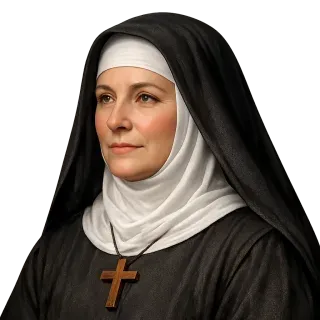
Hildegard of Bingen
The Sybil of the Rhine, mystic, abbess, composer, healer, and voice of the Living Light.
Explore Hildegard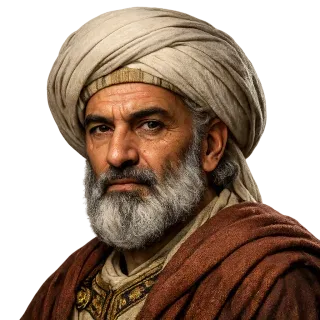
Ibn Rushd
The Commentator, who proved that faith and reason speak with one voice when both are true
Explore Averroes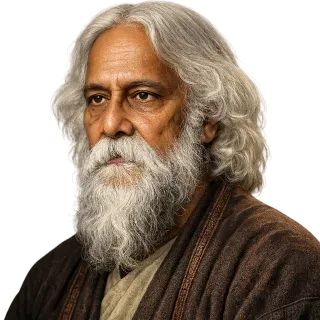
Rabindranath Tagore
The poet who made Bengal sing to the world, and who built a university under the trees.
Explore Tagore
Thomas Aquinas
The gentle genius who married Aristotle to Christ, and changed how the West thinks
Explore Aquinas
Adi Shankara
The wandering teacher who showed that liberation is not achievement but recognition of what you already are
Explore Shankara