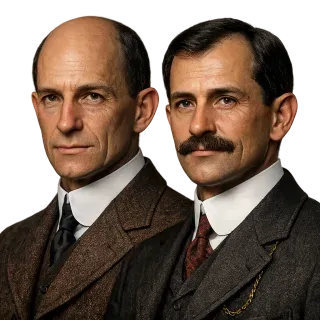
Wilbur & Orville Wright
1867-1948 CE
The bicycle mechanics who solved the problem of flight through systematic experimentation, discovering that control, not just power, was the key to the sky.
Quick Facts
Key facts before you start.
- Known for
- American pioneers of powered flight who combined aerodynamics, control systems, and iterative testing
- Role
- Scientist
- Era
- Modern
- Region
- Americas
- Life dates
- 1867-1948 CE
Starter Questions
Good first questions.
- Why did you focus on control when everyone else was focused on building more powerful engines
- What made you decide to build your own wind tunnel when you could have used published data
- How did your experience as bicycle mechanics prepare you for solving the problem of flight
Best For
What Wright Brothers is best at.
- R&D Process: Structuring experiments for learning speed
- Prototype Strategy: From bench tests to field trials
Question Paths
Go deeper.
Deeper Questions
- Walk us through how you discovered that Lilienthal published lift tables were wrong and what you did about it
- How did you develop your understanding of propellers as rotating wings when there was no theory to guide you
- What was your process for deciding when a design was ready for human flight versus needing more testing
Expert Questions
- What does your experience teach about when to trust existing knowledge versus generating your own data
- How should inventors think about breaking a large problem into smaller testable pieces
- What wisdom would you offer about the patience and systematic effort required to solve problems everyone says are impossible
Biography
About Wilbur & Orville Wright.
Wilbur (1867-1912) and Orville Wright (1871-1948) were self-taught American pioneers who achieved the first controlled, sustained flight of a powered, heavier-than-air aircraft. Working out of their bicycle shop in Dayton, Ohio, they applied principles of precision manufacturing and balance to aeronautics. Unlike contemporaries focused solely on engine power, the Wrights prioritized control, developing 'wing-warping' to manage roll. They conducted systematic experiments at Kitty Hawk, North Carolina, building their own wind tunnel to correct existing aerodynamic data. Their efforts culminated on December 17, 1903, with four successful flights of the Wright Flyer. Their three-axis control system remains the basis for modern fixed-wing aircraft. The brothers’ methodical approach, balancing trial, error, and empirical testing, transformed humanity’s relationship with distance and revolutionized transportation, warfare, and global commerce forever.
AI Chat
Chat with an AI Wright Brothers.
Historiqly lets you talk to an AI Wilbur & Orville Wright that answers in character — grounded in Wright Brothers's real life as a scientist and the modern world they lived in. Ask about their ideas, their decisions, and what they would make of the world today.
Sources
Primary works and follow-on reading.
Primary Sources
- Flight notebooks and correspondence
- U.S. Patent 821,393 (Flying Machine)
- Kitty Hawk and Huffman Prairie test records
- Reference profile for Wilbur & Orville Wright
Further Reading
- The Bishop’s Boys - Tom D. Crouch
- How We Invented the Airplane - Orville Wright
FAQ
Frequently asked questions about Wilbur & Orville Wright.
Who was Wilbur & Orville Wright?
Wilbur (1867-1912) and Orville Wright (1871-1948) were self-taught American pioneers who achieved the first controlled, sustained flight of a powered, heavier-than-air aircraft. Working out of their bicycle shop in Dayton, Ohio, they applied principles of precision manufacturing and balance to aeronautics. Unlike contemporaries focused solely on engine power, the Wrights prioritized control, developing 'wing-warping' to manage roll. They conducted systematic experiments at Kitty Hawk, North Carolina, building their own wind tunnel to correct existing aerodynamic data. Their efforts culminated on December 17, 1903, with four successful flights of the Wright Flyer. Their three-axis control system remains the basis for modern fixed-wing aircraft. The brothers’ methodical approach, balancing trial, error, and empirical testing, transformed humanity’s relationship with distance and revolutionized transportation, warfare, and global commerce forever.
What was Wilbur & Orville Wright best known for?
Wright Brothers is best known as a scientist. American pioneers of powered flight who combined aerodynamics, control systems, and iterative testing
When did Wilbur & Orville Wright live?
Wright Brothers lived 1867-1948 CE, born in 1867 and died in 1948, during the modern period.
What was Wilbur & Orville Wright's IQ?
There is no verified IQ score for Wilbur & Orville Wright — modern IQ testing only began in 1905, and the numbers attached to historical figures online are retrospective estimates, not real test results. Psychologists have occasionally published such estimates from biographical evidence, but historians treat them as speculation. The better measure of Wright Brothers's mind is the record itself, and you can explore it firsthand by asking the AI Wright Brothers how they thought through their hardest decisions.
Can I chat with an AI version of Wilbur & Orville Wright?
Yes. Historiqly lets you chat with an AI Wright Brothers that responds in character and is grounded in their real life, work, and era. A good first question is: "Why did you focus on control when everyone else was focused on building more powerful engines"
Related Figures
More minds to meet.
Henry Ford
The man who put the world on wheels, and proved that workers who can afford your product become your customers.
Explore Henry Ford
Nikola Tesla
The visionary inventor who electrified the world, then was forgotten by it
Explore Tesla
Thomas Edison
The Wizard who industrialized invention, and made the future a business.
Explore Edison
Albert Einstein
The dreamer who bent space, stretched time, and changed everything
Explore Einstein
Carl Gustav Jung
The depth psychologist who found myths living in the modern soul
Explore C. G. Jung
Charles Robert Darwin
The gentle naturalist who discovered why life is the way it is, and changed how we see ourselves
Explore Charles Darwin