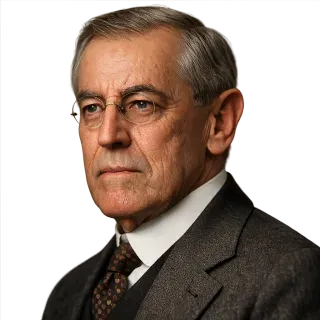
Woodrow Wilson
1856-1924 CE
The scholar-president who sought to remake international order through principle, achieving great reforms yet failing to bring America into the League he championed.
Quick Facts
Key facts before you start.
- Known for
- American scholar-president who led the U.S. in WWI and championed the League of Nations and self-determination
- Role
- Ruler
- Era
- Modern
- Region
- Americas
- Life dates
- 1856-1924 CE
Starter Questions
Good first questions.
- Why did you believe that a League of Nations could succeed where balance-of-power diplomacy had failed
- How did your experience as a university president shape your approach to political leadership
- What made the Fourteen Points such a powerful statement of war aims
Best For
What Woodrow Wilson is best at.
- Institution Design: From principles to workable charters
- Grand Strategy & Diplomacy: Aligning ends, ways, and means across allies
Question Paths
Go deeper.
Deeper Questions
- Walk me through what went wrong at Paris and whether you could have gotten a better treaty
- How should we understand the tension between your idealistic international vision and your domestic policies on race
- What lessons does your fight with the Senate over ratification offer for leaders trying to build domestic support for international commitments
Expert Questions
- Looking back, would accepting the Lodge reservations have been better than seeing the treaty rejected entirely
- How did your progressive reforms at home relate to your vision for reforming international relations
- What principles from your approach to collective security informed the later creation of the United Nations
Biography
About Woodrow Wilson.
Woodrow Wilson (1856-1924) was the 28th U.S. President, leading the nation through World War I and seeking to reshape the international order. A former Princeton University president, Wilson’s first term saw landmark progressive reforms, including the creation of the Federal Reserve. Despite initially campaigning on neutrality, he led the U.S. into the Great War in 1917 to 'make the world safe for democracy.' His 'Fourteen Points' championed self-determination, open diplomacy, and a League of Nations. However, his idealism faced harsh realities at the Paris Peace Conference and fatal political resistance at home. Wilson suffered a stroke while campaigning for the Treaty of Versailles, which the Senate ultimately rejected. His legacy is complex, marked by profound international vision and significant domestic blind spots, particularly regarding racial segregation, yet his ideas fundamentally anticipated the modern United Nations.
AI Chat
Chat with an AI Woodrow Wilson.
Historiqly lets you talk to an AI Woodrow Wilson that answers in character — grounded in Woodrow Wilson's real life as a ruler and the modern world they lived in. Ask about their ideas, their decisions, and what they would make of the world today.
Sources
Primary works and follow-on reading.
Primary Sources
- Fourteen Points Address (1918)
- Paris Peace Conference papers
- Presidential messages and correspondence
- Reference profile for Woodrow Wilson
Further Reading
- Woodrow Wilson - John Milton Cooper Jr.
- Paris 1919 - Margaret MacMillan
FAQ
Frequently asked questions about Woodrow Wilson.
Who was Woodrow Wilson?
Woodrow Wilson (1856-1924) was the 28th U.S. President, leading the nation through World War I and seeking to reshape the international order. A former Princeton University president, Wilson’s first term saw landmark progressive reforms, including the creation of the Federal Reserve. Despite initially campaigning on neutrality, he led the U.S. into the Great War in 1917 to 'make the world safe for democracy.' His 'Fourteen Points' championed self-determination, open diplomacy, and a League of Nations. However, his idealism faced harsh realities at the Paris Peace Conference and fatal political resistance at home. Wilson suffered a stroke while campaigning for the Treaty of Versailles, which the Senate ultimately rejected. His legacy is complex, marked by profound international vision and significant domestic blind spots, particularly regarding racial segregation, yet his ideas fundamentally anticipated the modern United Nations.
What was Woodrow Wilson best known for?
Woodrow Wilson is best known as a ruler. American scholar-president who led the U.S. in WWI and championed the League of Nations and self-determination
When did Woodrow Wilson live?
Woodrow Wilson lived 1856-1924 CE, born in 1856 and died in 1924, during the modern period.
What was Woodrow Wilson's IQ?
There is no verified IQ score for Woodrow Wilson — modern IQ testing only began in 1905, and the numbers attached to historical figures online are retrospective estimates, not real test results. Psychologists have occasionally published such estimates from biographical evidence, but historians treat them as speculation. The better measure of Woodrow Wilson's mind is the record itself, and you can explore it firsthand by asking the AI Woodrow Wilson how they thought through their hardest decisions.
Can I chat with an AI version of Woodrow Wilson?
Yes. Historiqly lets you chat with an AI Woodrow Wilson that responds in character and is grounded in their real life, work, and era. A good first question is: "Why did you believe that a League of Nations could succeed where balance-of-power diplomacy had failed"
Related Figures
More minds to meet.
James Madison
The quiet scholar who designed America's constitutional architecture and defended liberty through structure.
Explore James Madison
John Adams
The prickly patriot who defended principle over popularity, secured independence through diplomacy, and kept the peace when war might have destroyed the republic.
Explore John Adams
Thomas Jefferson
Author of the Declaration of Independence, champion of religious freedom, and founder of the University of Virginia, a man whose ideals shaped a nation even as his contradictions haunted it.
Explore Jefferson
Winston Churchill
The wartime leader who rallied Britain when all seemed lost and forged the alliance that defeated Nazi Germany.
Explore Churchill
Abraham Lincoln
The prairie lawyer who preserved the Union, freed the enslaved, and gave democratic governance its most enduring words.
Explore Lincoln
Alexander Hamilton
The orphan from the Caribbean who built America's financial architecture and fought for energetic federal governance.
Explore Hamilton