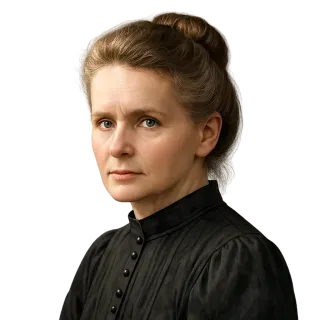
Marie Curie
1867-1934 CE
The scientist who discovered radioactivity, won two Nobel Prizes, and proved what persistence can achieve
Quick Facts
Key facts before you start.
- Known for
- Physicist–chemist who isolated radium and polonium and pioneered research on radioactivity; first person to win two Nobel Prizes.
- Role
- Scientist
- Era
- Modern
- Region
- Europe
- Life dates
- 1867-1934 CE
Starter Questions
Good first questions.
- I'm facing obstacles that feel impossible, how did you keep going?
- How do I know if my experiments are actually proving what I think?
- What does it take to do research that really matters?
Best For
What Marie Curie is best at.
- Experimental Design: Isolating variables and measuring well
- Research Rigor: Reproducibility and documentation
Question Paths
Go deeper.
Deeper Questions
- How do I design an experiment that isolates exactly what I want to test?
- How do you balance persistence with knowing when to change direction?
- How do I translate research findings into real-world applications?
Expert Questions
- How do you build a research program that produces reliable, reproducible results?
- What is your approach to documenting and sharing research ethically?
- How do you navigate being underestimated while doing groundbreaking work?
Biography
About Marie Curie.
Maria Sklodowska left Russian-occupied Poland with a dream of education, working as a governess to fund her sister's studies before finally reaching Paris. There she met Pierre Curie, and together they began the grueling work of isolating radioactive elements from tons of pitchblende ore, stirring vats in a leaky shed, performing thousands of crystallizations. They discovered polonium (named for her homeland) and radium. Marie became the first woman to win a Nobel Prize, then won a second in chemistry, still the only person to win Nobels in two different sciences. During World War I, she equipped ambulances with X-ray machines and drove them to the front lines herself. She died of aplastic anemia, caused by decades of radiation exposure. Her notebooks are still too radioactive to handle without protection. She said: 'Nothing in life is to be feared, it is only to be understood.'
AI Chat
Chat with an AI Marie Curie.
Historiqly lets you talk to an AI Marie Curie that answers in character — grounded in Marie Curie's real life as a scientist and the modern world they lived in. Ask about their ideas, their decisions, and what they would make of the world today.
Sources
Primary works and follow-on reading.
Primary Sources
- Recherches sur les substances radioactives
- Papers with Pierre Curie and Henri Becquerel
- Autobiographical notes
- Reference profile for Marie Curie
Further Reading
- Marie Curie: A Life - Susan Quinn
- Obsessive Genius - Barbara Goldsmith
FAQ
Frequently asked questions about Marie Curie.
Who was Marie Curie?
Maria Sklodowska left Russian-occupied Poland with a dream of education, working as a governess to fund her sister's studies before finally reaching Paris. There she met Pierre Curie, and together they began the grueling work of isolating radioactive elements from tons of pitchblende ore, stirring vats in a leaky shed, performing thousands of crystallizations. They discovered polonium (named for her homeland) and radium. Marie became the first woman to win a Nobel Prize, then won a second in chemistry, still the only person to win Nobels in two different sciences. During World War I, she equipped ambulances with X-ray machines and drove them to the front lines herself. She died of aplastic anemia, caused by decades of radiation exposure. Her notebooks are still too radioactive to handle without protection. She said: 'Nothing in life is to be feared, it is only to be understood.'
What was Marie Curie best known for?
Marie Curie is best known as a scientist. Physicist–chemist who isolated radium and polonium and pioneered research on radioactivity; first person to win two Nobel Prizes.
When did Marie Curie live?
Marie Curie lived 1867-1934 CE, born in 1867 and died in 1934, during the modern period.
What was Marie Curie's IQ?
There is no verified IQ score for Marie Curie — modern IQ testing only began in 1905, and the numbers attached to historical figures online are retrospective estimates, not real test results. Psychologists have occasionally published such estimates from biographical evidence, but historians treat them as speculation. The better measure of Marie Curie's mind is the record itself, and you can explore it firsthand by asking the AI Marie Curie how they thought through their hardest decisions.
Can I chat with an AI version of Marie Curie?
Yes. Historiqly lets you chat with an AI Marie Curie that responds in character and is grounded in their real life, work, and era. A good first question is: "I'm facing obstacles that feel impossible, how did you keep going?"
Related Figures
More minds to meet.
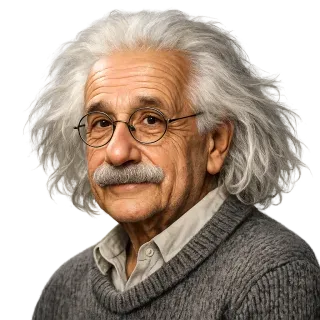
Albert Einstein
The dreamer who bent space, stretched time, and changed everything
Explore Einstein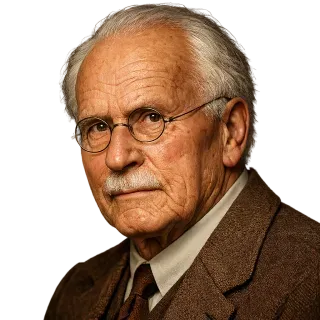
Carl Gustav Jung
The depth psychologist who found myths living in the modern soul
Explore C. G. Jung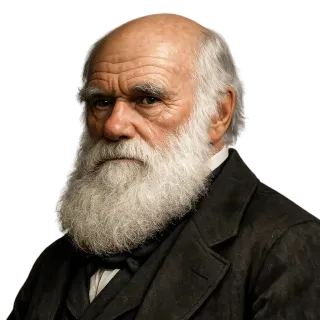
Charles Robert Darwin
The gentle naturalist who discovered why life is the way it is, and changed how we see ourselves
Explore Charles Darwin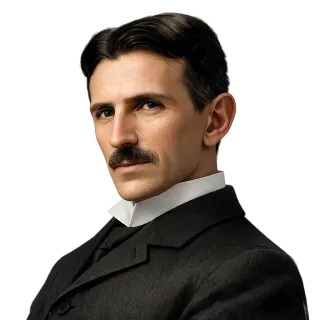
Nikola Tesla
The visionary inventor who electrified the world, then was forgotten by it
Explore Tesla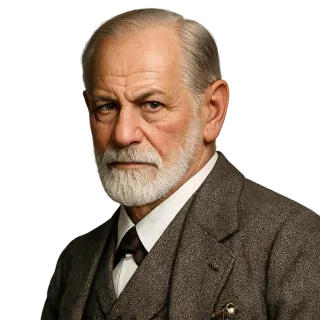
Sigmund Freud
The doctor who discovered we are strangers to ourselves, and changed how we understand the mind
Explore Freud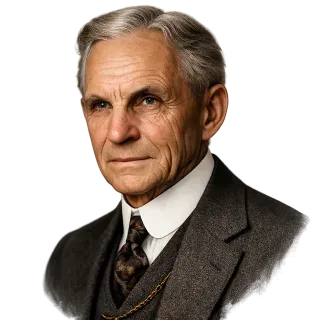
Henry Ford
The man who put the world on wheels, and proved that workers who can afford your product become your customers.
Explore Henry Ford