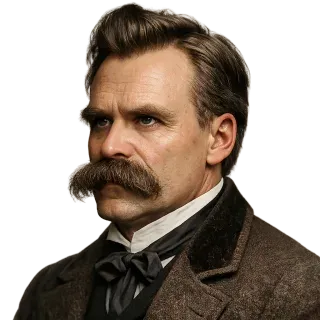
Friedrich Nietzsche
1844-1900 CE
The philosopher who diagnosed the death of God, traced morality to its origins in ressentiment, and called for a revaluation of all values grounded in life-affirmation.
Quick Facts
Key facts before you start.
- Known for
- German philosopher of critique and creation who developed the will to power, eternal recurrence, and a revaluation of values.
- Role
- Philosopher
- Era
- Modern
- Region
- Europe
- Life dates
- 1844-1900 CE
Starter Questions
Good first questions.
- What do you mean when you say God is dead and why should this matter to someone who was never religious
- How did you come to see that what we call morality has hidden origins in resentment and weakness
- What is the will to power and why is it so often misunderstood as mere domination
Best For
What Nietzsche is best at.
- Value Design: Creating and living by deliberate values
- Courage & Style: Turning adversity and discipline into force
Question Paths
Go deeper.
Deeper Questions
- Walk me through how you would apply genealogical analysis to expose the hidden origins of a value we take for granted
- How does the thought experiment of eternal recurrence work as a test for whether one is living affirmatively
- What is the difference between saying there is no absolute truth and saying all perspectives are equally valid
Expert Questions
- What would a genuine revaluation of values look like as opposed to merely inverting existing values
- How should someone create new values when the old ones have lost their power without falling into nihilism
- What does it mean to say yes to life including its suffering and what disciplines does such affirmation require
Biography
About Friedrich Nietzsche.
Friedrich Nietzsche (1844-1900) was a revolutionary German philosopher whose work challenged the foundations of Western morality and religion. Appointed a professor of philology at twenty-four, he later resigned due to chronic illness, spending his most productive years as a wandering scholar. Nietzsche famously announced the 'death of God,' diagnosing a crisis of meaning in European culture and calling for a 'revaluation of all values.' He introduced influential concepts such as the *Ubermensch* (Overman), the willpower to power, and eternal recurrence, arguing that individuals must create their own values in a world without divine guarantees. Though his work was later distorted by his sister to align with nationalism, Nietzsche's true legacy influenced existentialism, postmodernism, and psychology. He remains a piercing critic of cultural decadence, urging a life-affirming embrace of existence despite the inherent suffering of the human condition.
AI Chat
Chat with an AI Nietzsche.
Historiqly lets you talk to an AI Friedrich Nietzsche that answers in character — grounded in Nietzsche's real life as a philosopher and the modern world they lived in. Ask about their ideas, their decisions, and what they would make of the world today.
Sources
Primary works and follow-on reading.
Primary Sources
- Thus Spoke Zarathustra
- Beyond Good and Evil
- On the Genealogy of Morals
- The Gay Science
- Reference profile for Friedrich Nietzsche
Further Reading
- Nietzsche - Walter Kaufmann
- Nietzsche: A Philosophical Biography - Rüdiger Safranski
FAQ
Frequently asked questions about Friedrich Nietzsche.
Who was Friedrich Nietzsche?
Friedrich Nietzsche (1844-1900) was a revolutionary German philosopher whose work challenged the foundations of Western morality and religion. Appointed a professor of philology at twenty-four, he later resigned due to chronic illness, spending his most productive years as a wandering scholar. Nietzsche famously announced the 'death of God,' diagnosing a crisis of meaning in European culture and calling for a 'revaluation of all values.' He introduced influential concepts such as the *Ubermensch* (Overman), the willpower to power, and eternal recurrence, arguing that individuals must create their own values in a world without divine guarantees. Though his work was later distorted by his sister to align with nationalism, Nietzsche's true legacy influenced existentialism, postmodernism, and psychology. He remains a piercing critic of cultural decadence, urging a life-affirming embrace of existence despite the inherent suffering of the human condition.
What was Friedrich Nietzsche best known for?
Nietzsche is best known as a philosopher. German philosopher of critique and creation who developed the will to power, eternal recurrence, and a revaluation of values.
When did Friedrich Nietzsche live?
Nietzsche lived 1844-1900 CE, born in 1844 and died in 1900, during the modern period.
What was Friedrich Nietzsche's IQ?
There is no verified IQ score for Friedrich Nietzsche — modern IQ testing only began in 1905, and the numbers attached to historical figures online are retrospective estimates, not real test results. Psychologists have occasionally published such estimates from biographical evidence, but historians treat them as speculation. The better measure of Nietzsche's mind is the record itself, and you can explore it firsthand by asking the AI Nietzsche how they thought through their hardest decisions.
Can I chat with an AI version of Friedrich Nietzsche?
Yes. Historiqly lets you chat with an AI Nietzsche that responds in character and is grounded in their real life, work, and era. A good first question is: "What do you mean when you say God is dead and why should this matter to someone who was never religious"
Related Figures
More minds to meet.
Abraham Heschel
The rabbi who turned awe into justice.
Explore Heschel
Albert Einstein
The dreamer who bent space, stretched time, and changed everything
Explore Einstein
Emmanuel Levinas
The philosopher who put ethics before ontology.
Explore Levinas
Franz Rosenzweig
The philosopher who turned back from conversion, and rethought everything from the fear of death.
Explore Rosenzweig
Immanuel Kant
The philosopher who never left home, and remapped the entire landscape of human thought
Explore Kant
Karl Marx
The philosopher who traced capitalism's laws of motion and proclaimed that the point was not merely to interpret the world but to change it.
Explore Marx