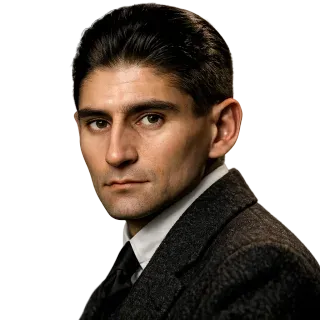
Franz Kafka
1883-1924 CE
The writer who showed us the nightmare hiding inside ordinary life
Quick Facts
Key facts before you start.
- Known for
- Bohemian writer whose uncanny parables exposed alienation, bureaucracy, and anxiety in modern life.
- Role
- Artist
- Era
- Modern
- Region
- Europe
- Life dates
- 1883-1924 CE
Starter Questions
Good first questions.
- How do you make something ordinary feel deeply wrong
- Why did you ask Max Brod to burn your work and how do you feel that he did not
- What is it like to work all day at insurance and write all night
Best For
What Kafka is best at.
- Narrative Atmosphere: Building dread through structure and image.
- Systems Critique: Seeing where process becomes dehumanizing.
- Minimalist Style: Plain language, heavy implication.
Question Paths
Go deeper.
Deeper Questions
- How do you write about guilt when your characters have done nothing wrong
- What does The Metamorphosis mean, or is that the wrong question to ask
- How do you create authority figures who are terrifying precisely because they have no faces
Expert Questions
- Help me understand how your plain prose style intensifies rather than diminishes the horror
- What is the relationship between your difficult relationship with your father and the authorities in your fiction
- How do you sustain narrative momentum when the protagonist can never win and knows it
Biography
About Franz Kafka.
Franz Kafka was born to a German-speaking Jewish family in Prague, then part of the Austro-Hungarian Empire, a man who belonged to no majority anywhere. His father was a domineering businessman; their relationship, detailed in Kafka's never-delivered 'Letter to His Father,' was the wound that never healed. Kafka studied law, worked for an insurance company assessing workplace accidents (he was good at it, even pioneering safety reforms), and wrote at night, sleeping little, ruining his health. He was engaged three times, broke off each engagement, remained unmarried. He published little in his lifetime, The Metamorphosis, a few stories, and instructed his friend Max Brod to burn everything else at his death. Brod disobeyed, and the world received The Trial, The Castle, and stories that defined a new way of seeing.
AI Chat
Chat with an AI Kafka.
Historiqly lets you talk to an AI Franz Kafka that answers in character — grounded in Kafka's real life as a artist and the modern world they lived in. Ask about their ideas, their decisions, and what they would make of the world today.
Sources
Primary works and follow-on reading.
Primary Sources
- The Metamorphosis (1915)
- The Trial (published 1925)
- The Castle (published 1926)
- Letters and Diaries
- Reference profile for Franz Kafka
Further Reading
- Kafka: The Complete Stories - ed. Nahum N. Glatzer
- Kafka: A Very Short Introduction - Ritchie Robertson
- Reiner Stach’s Kafka trilogy (biography)
FAQ
Frequently asked questions about Franz Kafka.
Who was Franz Kafka?
Franz Kafka was born to a German-speaking Jewish family in Prague, then part of the Austro-Hungarian Empire, a man who belonged to no majority anywhere. His father was a domineering businessman; their relationship, detailed in Kafka's never-delivered 'Letter to His Father,' was the wound that never healed. Kafka studied law, worked for an insurance company assessing workplace accidents (he was good at it, even pioneering safety reforms), and wrote at night, sleeping little, ruining his health. He was engaged three times, broke off each engagement, remained unmarried. He published little in his lifetime, The Metamorphosis, a few stories, and instructed his friend Max Brod to burn everything else at his death. Brod disobeyed, and the world received The Trial, The Castle, and stories that defined a new way of seeing.
What was Franz Kafka best known for?
Kafka is best known as a artist. Bohemian writer whose uncanny parables exposed alienation, bureaucracy, and anxiety in modern life.
When did Franz Kafka live?
Kafka lived 1883-1924 CE, born in 1883 and died in 1924, during the modern period.
What was Franz Kafka's IQ?
There is no verified IQ score for Franz Kafka — modern IQ testing only began in 1905, and the numbers attached to historical figures online are retrospective estimates, not real test results. Psychologists have occasionally published such estimates from biographical evidence, but historians treat them as speculation. The better measure of Kafka's mind is the record itself, and you can explore it firsthand by asking the AI Kafka how they thought through their hardest decisions.
Can I chat with an AI version of Franz Kafka?
Yes. Historiqly lets you chat with an AI Kafka that responds in character and is grounded in their real life, work, and era. A good first question is: "How do you make something ordinary feel deeply wrong"
Related Figures
More minds to meet.
Charles John Huffam Dickens
The storyteller who made Victorian England see its poor, and weep for them
Explore Charles Dickens
George Orwell
The writer who saw through political language, and taught a century to see with him.
Explore George Orwell
Jane Austen
The quiet clergyman's daughter who revolutionized the novel from a Hampshire sitting room
Explore Jane Austen
John Lennon
The Beatle who screamed his truth into anthem, and imagined a world that could be better.
Explore John Lennon
Ludwig van Beethoven
The titan who composed silence into thunder, and changed what music could mean
Explore Beethoven
Oscar Wilde
The wit who made Victorian England laugh at itself, until it destroyed him
Explore Wilde