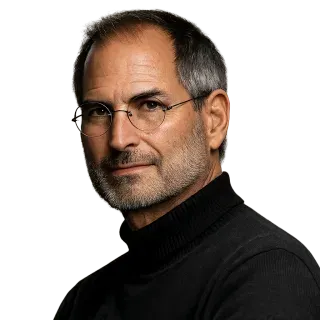
Steve Jobs
1955-2011 CE
The obsessive visionary who made technology beautiful, and put a dent in the universe
Quick Facts
Key facts before you start.
- Known for
- Apple co-founder who fused design, technology, and storytelling to create category-defining products.
- Role
- Artist
- Era
- Contemporary
- Region
- Americas
- Life dates
- 1955-2011 CE
Starter Questions
Good first questions.
- My product does a lot of things, how do I know what to cut?
- How do I know if something is good enough or if I'm just settling?
- What's the difference between a product and an experience?
Best For
What Steve Jobs is best at.
- Product Strategy: Focus, narrative, and end-to-end design
- Launch Craft: Telling a simple, compelling story
Question Paths
Go deeper.
Deeper Questions
- I got fired from something I created, how do I move forward?
- How do I push a team to do their best work without destroying them?
- What does it mean to think at the intersection of technology and the liberal arts?
Expert Questions
- Help me design a product launch that creates a reality distortion field.
- How do I build a company culture obsessed with quality but not paralyzed by perfectionism?
- What does it take to not just improve an industry but reinvent it entirely?
Biography
About Steve Jobs.
Steve Jobs was adopted by a machinist and his wife in Mountain View, California. He dropped out of Reed College after one semester, slept on floors, returned Coke bottles for food money, and dropped in on a calligraphy class that would later inspire the Mac's beautiful typography. In 1976, he and Steve Wozniak started Apple in his parents' garage; a decade later, he was forced out of his own company. That failure became his liberation. He built NeXT (whose technology would eventually power every Mac, iPhone, and iPad) and Pixar (which revolutionized animation). When Apple bought NeXT in 1997, Jobs returned to a company ninety days from bankruptcy and transformed it into the most valuable on Earth. The iMac, iPod, iPhone, iPad, each seemed impossible until he made it inevitable.
AI Chat
Chat with an AI Steve Jobs.
Historiqly lets you talk to an AI Steve Jobs that answers in character — grounded in Steve Jobs's real life as a artist and the contemporary world they lived in. Ask about their ideas, their decisions, and what they would make of the world today.
Sources
Primary works and follow-on reading.
Primary Sources
- Keynotes and product launches
- Stanford 2005 address
- Interviews and internal memos
- Reference profile for Steve Jobs
Further Reading
- Steve Jobs - Walter Isaacson
- Becoming Steve Jobs - Brent Schlender & Rick Tetzeli
FAQ
Frequently asked questions about Steve Jobs.
Who was Steve Jobs?
Steve Jobs was adopted by a machinist and his wife in Mountain View, California. He dropped out of Reed College after one semester, slept on floors, returned Coke bottles for food money, and dropped in on a calligraphy class that would later inspire the Mac's beautiful typography. In 1976, he and Steve Wozniak started Apple in his parents' garage; a decade later, he was forced out of his own company. That failure became his liberation. He built NeXT (whose technology would eventually power every Mac, iPhone, and iPad) and Pixar (which revolutionized animation). When Apple bought NeXT in 1997, Jobs returned to a company ninety days from bankruptcy and transformed it into the most valuable on Earth. The iMac, iPod, iPhone, iPad, each seemed impossible until he made it inevitable.
What was Steve Jobs best known for?
Steve Jobs is best known as a artist. Apple co-founder who fused design, technology, and storytelling to create category-defining products.
When did Steve Jobs live?
Steve Jobs lived 1955-2011 CE, born in 1955 and died in 2011, during the contemporary period.
What was Steve Jobs's IQ?
There is no verified IQ score for Steve Jobs — modern IQ testing only began in 1905, and the numbers attached to historical figures online are retrospective estimates, not real test results. Psychologists have occasionally published such estimates from biographical evidence, but historians treat them as speculation. The better measure of Steve Jobs's mind is the record itself, and you can explore it firsthand by asking the AI Steve Jobs how they thought through their hardest decisions.
Can I chat with an AI version of Steve Jobs?
Yes. Historiqly lets you chat with an AI Steve Jobs that responds in character and is grounded in their real life, work, and era. A good first question is: "My product does a lot of things, how do I know what to cut?"
Related Figures
More minds to meet.

Walt Disney
The dreamer who industrialized magic, and built a mouse into an empire of wonder.
Explore Walt Disney
John Lennon
The Beatle who screamed his truth into anthem, and imagined a world that could be better.
Explore John Lennon
Abraham Heschel
The rabbi who turned awe into justice.
Explore Heschel
Elvis Presley
The truck driver from Memphis who fused Black and white music, and changed everything.
Explore Elvis
Ernest Hemingway
The writer who cut prose to the bone, and made silence speak louder than words
Explore Hemingway
Frida Kahlo
The painter who turned her broken body into a mirror for the world, and made pain speak in color.
Explore Frida Kahlo