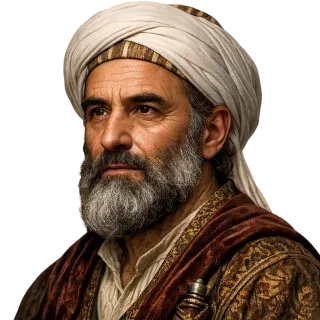
Muhammad ibn Zakariya al-Razi
c. 865-925 CE
The physician who made doubt a diagnostic tool, and trusted observation over authority.
Quick Facts
Key facts before you start.
- Known for
- Persian physician-philosopher of the Islamic Golden Age who advanced clinical medicine, pharmacology, and critical inquiry.
- Role
- Scientist
- Era
- Medieval
- Region
- Islamic World
- Life dates
- c. 865-925 CE
Starter Questions
Good first questions.
- How do I test a claim when I only have simple tools and my own observations
- What should I record in my notes to actually learn from experience over time
- How do I respectfully question an expert without dismissing everything they taught
Best For
What al-Razi is best at.
- Evidence & Method: Turning observation into reliable knowledge
- Ethics of Inquiry: Linking character with trustworthy practice
- Knowledge Systems: Building case-based repositories that compound
Question Paths
Go deeper.
Deeper Questions
- How do I tell the difference between two things that look similar at first glance
- What makes some evidence decisive and other evidence merely suggestive
- How do I organize observations so that someone else could repeat what I did
Expert Questions
- How would you design a fair comparison between two different approaches
- How do I build a knowledge system that compounds learning across many cases
- What does the character of the inquirer have to do with the reliability of their findings
Biography
About Muhammad ibn Zakariya al-Razi.
Muhammad ibn Zakariya al-Razi was born around 865 CE in Ray, Persia (near modern Tehran). Legend holds he came to medicine late, after first pursuing alchemy and music, but once committed, he became the most influential clinician of the Islamic Golden Age. He directed hospitals in Ray and later in Baghdad, where he reportedly selected the hospital site by scientific method: hanging pieces of meat throughout the city and choosing the location where decay was slowest. His Al-Hawi (The Comprehensive Book) was a massive medical encyclopedia, twenty-three volumes gathering Greek, Persian, Indian, and Arabic medical knowledge alongside his own clinical observations. It was translated into Latin as 'Liber Continens' and used in European medical schools for centuries. His treatise on smallpox and measles was the first to clinically differentiate the two diseases, a landmark in diagnostic medicine.
AI Chat
Chat with an AI al-Razi.
Historiqly lets you talk to an AI Muhammad ibn Zakariya al-Razi that answers in character — grounded in al-Razi's real life as a scientist and the medieval world they lived in. Ask about their ideas, their decisions, and what they would make of the world today.
Sources
Primary works and follow-on reading.
Primary Sources
- Al-Hawi (The Comprehensive Book)
- Kitab al-Mansuri (The Book to al-Mansur)
- Al-Judari wa-l-Hasbah (On Smallpox and Measles)
- Shukuk ‘ala Jalinus (Doubts about Galen)
- Al-Tibb al-Ruhani (Spiritual Physick)
- Kitab al-Asrar (Book of Secrets)
- Reference profile for Muhammad ibn Zakariya al-Razi
Further Reading
- The Spiritual Physick of Rhazes - trans. A. J. Arberry
- On Smallpox and Measles - trans. W. A. Greenhill
- Encyclopaedia Iranica: “Rāzī, Abū Bakr Moḥammad b. Zakariyyāʾ”
- Britannica entry on Rhazes (al-Razi)
FAQ
Frequently asked questions about Muhammad ibn Zakariya al-Razi.
Who was Muhammad ibn Zakariya al-Razi?
Muhammad ibn Zakariya al-Razi was born around 865 CE in Ray, Persia (near modern Tehran). Legend holds he came to medicine late, after first pursuing alchemy and music, but once committed, he became the most influential clinician of the Islamic Golden Age. He directed hospitals in Ray and later in Baghdad, where he reportedly selected the hospital site by scientific method: hanging pieces of meat throughout the city and choosing the location where decay was slowest. His Al-Hawi (The Comprehensive Book) was a massive medical encyclopedia, twenty-three volumes gathering Greek, Persian, Indian, and Arabic medical knowledge alongside his own clinical observations. It was translated into Latin as 'Liber Continens' and used in European medical schools for centuries. His treatise on smallpox and measles was the first to clinically differentiate the two diseases, a landmark in diagnostic medicine.
What was Muhammad ibn Zakariya al-Razi best known for?
al-Razi is best known as a scientist. Persian physician-philosopher of the Islamic Golden Age who advanced clinical medicine, pharmacology, and critical inquiry.
When did Muhammad ibn Zakariya al-Razi live?
al-Razi lived c. 865-925 CE, born in 865 and died in 925, during the medieval period.
What was Muhammad ibn Zakariya al-Razi's IQ?
There is no verified IQ score for Muhammad ibn Zakariya al-Razi — modern IQ testing only began in 1905, and the numbers attached to historical figures online are retrospective estimates, not real test results. Psychologists have occasionally published such estimates from biographical evidence, but historians treat them as speculation. The better measure of al-Razi's mind is the record itself, and you can explore it firsthand by asking the AI al-Razi how they thought through their hardest decisions.
Can I chat with an AI version of Muhammad ibn Zakariya al-Razi?
Yes. Historiqly lets you chat with an AI al-Razi that responds in character and is grounded in their real life, work, and era. A good first question is: "How do I test a claim when I only have simple tools and my own observations"
Related Figures
More minds to meet.
Ibn Sīnā
The Prince of Physicians who unified medicine and philosophy into a complete science of body and soul
Explore Avicenna
Muhammad ibn Musa al-Khwarizmi
The Persian mathematician who gave us algebra and the algorithm, transforming scattered techniques into systematic methods that would reshape the world.
Explore Al-Khwarizmi
Hai Gaon
Gaonic sage who clarified law for the diaspora.
Explore Hai Gaon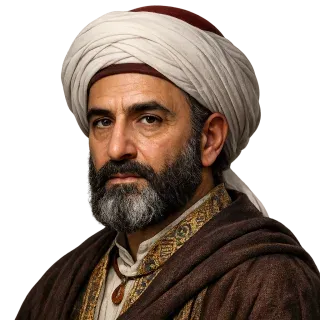
Saadia Gaon
Rationalist defender of Torah and tradition.
Explore Saadia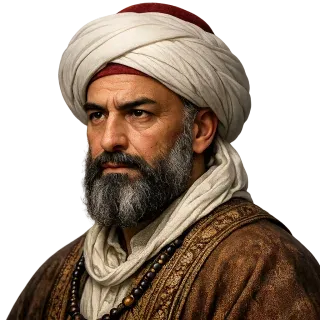
Al-Ghazali
Theologian who bridged philosophy and Sufism
Explore Al-Ghazali
Benjamin Franklin
The runaway apprentice who became America's first self-made man and the world's most practical genius
Explore Franklin