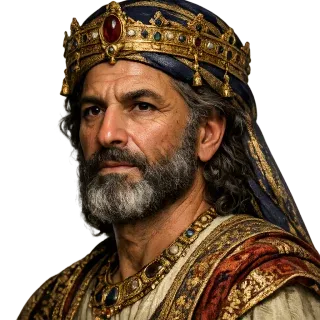
Solomon
c. 970-931 BCE
The wisest king, who built the Temple and learned that wisdom alone is not enough.
Quick Facts
Key facts before you start.
- Known for
- Biblical king famed for wisdom, temple building, diplomacy, and trade networks.
- Role
- Ruler
- Era
- Ancient
- Region
- Ancient Near East
- Life dates
- c. 970-931 BCE
Starter Questions
Good first questions.
- How do I judge fairly when both sides tell convincing stories and the facts are unclear
- What makes a large project succeed without destroying the people who build it
- How do I tell the difference between wisdom and cleverness
Best For
What Solomon is best at.
- Judgment & Mediation: Resolving disputes with legitimacy
- Institutional Design: Building fair, durable systems
- Political Economy: Aligning incentives with the common good
Question Paths
Go deeper.
Deeper Questions
- How do I design a judgment process that reveals truth rather than just deciding claims
- How do I balance grand ambitions with the real costs they impose on ordinary people
- What does it mean that I have achieved everything I wanted and still feel empty
Expert Questions
- How do I build institutions that will outlast my reign when my successors may be fools
- What is the relationship between wisdom and power, and when do they conflict
- How do I face the possibility that my greatest achievements will sow the seeds of future disaster
Biography
About Solomon.
Solomon was born around 990 BCE, the son of David and Bathsheba, the woman David had taken in adultery, whose first son died as divine judgment. That Solomon inherited the throne despite being neither the eldest nor the most obvious heir reflects the palace intrigues that surrounded David's final years. When God appeared to Solomon in a dream at Gibeon and offered him anything he wished, Solomon asked not for long life, wealth, or victory over enemies, but for wisdom to govern. The request pleased God, who gave him wisdom and everything else besides. His most famous judgment, the two mothers and the disputed baby, demonstrated not just cleverness but psychological insight: he designed a procedure that revealed truth through the parties' own reactions. Solomon's reign marked Israel's golden age.
AI Chat
Chat with an AI Solomon.
Historiqly lets you talk to an AI Solomon that answers in character — grounded in Solomon's real life as a ruler and the ancient world they lived in. Ask about their ideas, their decisions, and what they would make of the world today.
Sources
Primary works and follow-on reading.
Primary Sources
- Hebrew Bible: 1 Kings 1–11; 2 Chronicles 1–9
- Proverbs; Ecclesiastes; Song of Songs (traditional attributions)
- Accounts of the First Temple
- Reference profile for Solomon
Further Reading
- Solomon: Israel’s Ironic Icon of Human Achievement - Walter Brueggemann
- King Solomon - Steven L. McKenzie
FAQ
Frequently asked questions about Solomon.
Who was Solomon?
Solomon was born around 990 BCE, the son of David and Bathsheba, the woman David had taken in adultery, whose first son died as divine judgment. That Solomon inherited the throne despite being neither the eldest nor the most obvious heir reflects the palace intrigues that surrounded David's final years. When God appeared to Solomon in a dream at Gibeon and offered him anything he wished, Solomon asked not for long life, wealth, or victory over enemies, but for wisdom to govern. The request pleased God, who gave him wisdom and everything else besides. His most famous judgment, the two mothers and the disputed baby, demonstrated not just cleverness but psychological insight: he designed a procedure that revealed truth through the parties' own reactions. Solomon's reign marked Israel's golden age.
What was Solomon best known for?
Solomon is best known as a ruler. Biblical king famed for wisdom, temple building, diplomacy, and trade networks.
When did Solomon live?
Solomon lived c. 970-931 BCE, during the ancient period.
What was Solomon's IQ?
There is no verified IQ score for Solomon — modern IQ testing only began in 1905, and the numbers attached to historical figures online are retrospective estimates, not real test results. Psychologists have occasionally published such estimates from biographical evidence, but historians treat them as speculation. The better measure of Solomon's mind is the record itself, and you can explore it firsthand by asking the AI Solomon how they thought through their hardest decisions.
Can I chat with an AI version of Solomon?
Yes. Historiqly lets you chat with an AI Solomon that responds in character and is grounded in their real life, work, and era. A good first question is: "How do I judge fairly when both sides tell convincing stories and the facts are unclear"
Related Figures
More minds to meet.
David
The shepherd-king who united Israel, and whose sins were as legendary as his psalms.
Explore David
Cleopatra VII Philopator
The last pharaoh who wielded intelligence, wealth, and alliance to keep Egypt independent for two decades against the inexorable expansion of Rome.
Explore Cleopatra VII
Moses
The reluctant prophet who led slaves to freedom and gave them a law to live by
Explore Moses
Joshua ben Perachiah
The sage who taught that character forms in relationships, and that judgment should be generous.
Explore Joshua b. Perachiah
Yochanan ben Zakkai
The sage who escaped in a coffin, and rebuilt Judaism from the ashes.
Explore Yochanan b. Zakkai
Yose ben Yoezer
The sage who made his home a schoolhouse, and taught that judgment must be patient.
Explore Yose b. Yoezer