Personalize your discoveriesOptional interests and saved progress
Follow your interests.
Choose your interests, then save them to update the discovery below. You can also begin with the session already selected.
Leave all unchecked to include every interest.
How your discoveries are saved
Preferences and the latest 60 completed sessions save in your private account notebook when signed in, or on this device as a visitor. Unfinished sessions remain available when you return, including on another day. Collection notes are kept separately. Completed sessions help choose what comes next.
Your discovery
A battle is not a conquest
01 Read the story
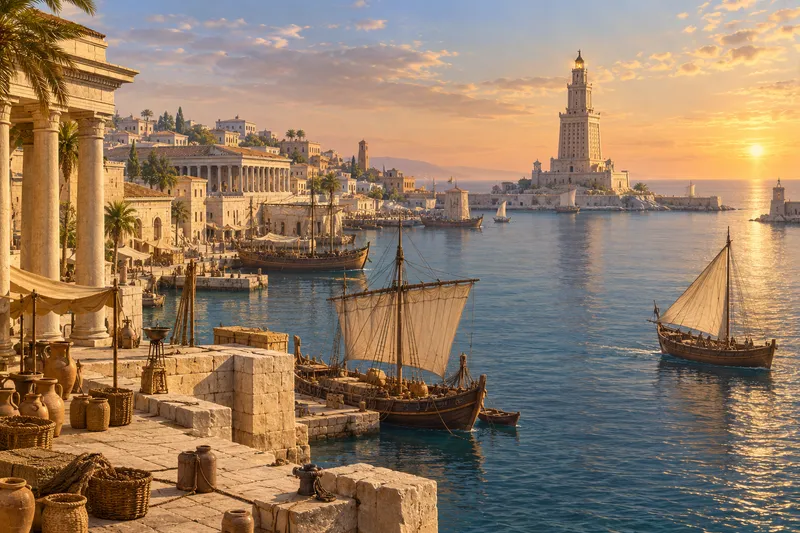
Alexandria imagined · AI illustration, not historical evidence
Actium took place in 31 BCE, off western Greece. Octavian reached Egypt in 30 BCE; Antony and Cleopatra died, and Egypt came under Roman rule.
From the linked sources. Topic: Cleopatra, Rome and the eastern Mediterranean.
02 · Place it in the world
A map supplies context.
Find Egypt and western Greece. What does the distance suggest about a naval campaign?
Selected year: 31 BCE · Border snapshot: 1 BCE. Borders are approximate reconstructions. Map methodology (opens in a new tab). Linked products keep their own access rules.
03 · Think it through
Optional · up to 500 characters
Save for later keeps an unfinished session. Finish records it as completed. Keeping it in a collection adds a separate copy of your note and its sources.
Continue the question
Keep following your curiosity.
Explore the places, people and evidence connected to this discovery.
Alexandria imagined · AI illustration, not historical evidence
In section 27 of the Res Gestae, Augustus claims the addition of Egypt to Roman rule. Compare the scale of that claim with the human and political story you have followed.
From the linked sources. Topic: Power and public accounts.
02 · Place it in the world
A map supplies context.
Locate Alexandria. Compare the place being conquered with the ruler speaking about it.
Selected year: 30 BCE · Border snapshot: 1 BCE. Borders are approximate reconstructions. Map methodology (opens in a new tab). Linked products keep their own access rules.
03 · Think it through
Optional · up to 500 characters
Save for later keeps an unfinished session. Finish records it as completed. Keeping it in a collection adds a separate copy of your note and its sources.
Continue the question
Keep following your curiosity.
Explore the places, people and evidence connected to this discovery.
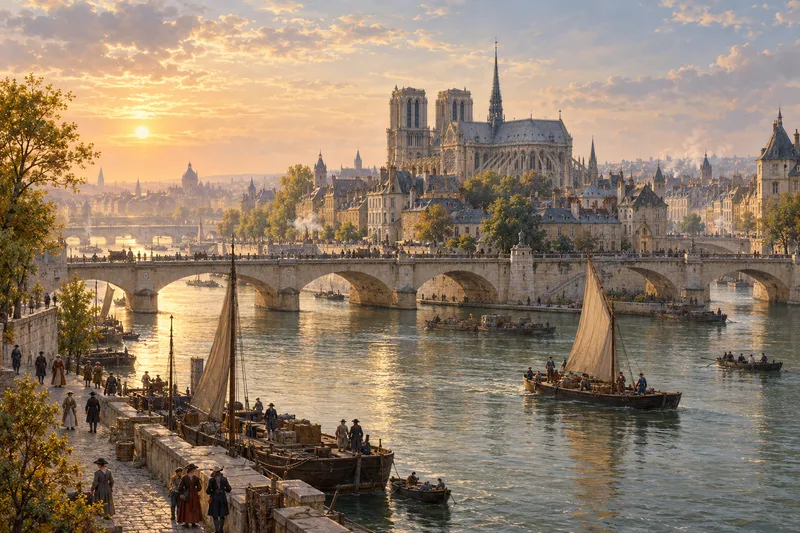
Paris imagined · AI illustration, not period evidence
Royal government and the city’s growing institutions reshaped medieval Paris. Think about the relationship between a capital and the territory governed from it.
From the linked sources. Topic: Paris, institutions and surviving places.
02 · Place it in the world
A map supplies context.
Find Paris and the surrounding political world. A border map shows a different scale from a city’s streets.
Selected year: 1200 CE · Border snapshot: 1200 CE. Borders are approximate reconstructions. Map methodology (opens in a new tab). Linked products keep their own access rules.
03 · Think it through
Optional · up to 500 characters
Save for later keeps an unfinished session. Finish records it as completed. Keeping it in a collection adds a separate copy of your note and its sources.
Continue the question
Keep following your curiosity.
Explore the places, people and evidence connected to this discovery.
Paris imagined · AI illustration, not period evidence
Events in Paris and nearby Versailles became connected through a crisis of political authority. Keep the two places distinct when tracing the Revolution.
From the linked sources. Topic: Connected places in the Revolution.
02 · Place it in the world
A map supplies context.
Locate Paris and nearby Versailles. Follow connected events without moving them into the same place.
Selected year: 1789 CE · Border snapshot: 1783 CE. Borders are approximate reconstructions. Map methodology (opens in a new tab). Linked products keep their own access rules.
03 · Think it through
Optional · up to 500 characters
Save for later keeps an unfinished session. Finish records it as completed. Keeping it in a collection adds a separate copy of your note and its sources.
Continue the question
Keep following your curiosity.
Explore the places, people and evidence connected to this discovery.
Selected year: 1912 CE · Border snapshot: 1914 CE. Borders are approximate reconstructions. Map methodology (opens in a new tab). Linked products keep their own access rules.
03 · Think it through
Optional · up to 500 characters
Save for later keeps an unfinished session. Finish records it as completed. Keeping it in a collection adds a separate copy of your note and its sources.
Continue the question
Keep following your curiosity.
Explore the places, people and evidence connected to this discovery.
Selected year: 1953 CE · Border snapshot: 1960 CE. Borders are approximate reconstructions. Map methodology (opens in a new tab). Linked products keep their own access rules.
03 · Think it through
Optional · up to 500 characters
Save for later keeps an unfinished session. Finish records it as completed. Keeping it in a collection adds a separate copy of your note and its sources.
Continue the question
Keep following your curiosity.
Explore the places, people and evidence connected to this discovery.